February 15, 2014

Make No Bones About It - Part 2


Bone Health is a growing concern.  The statistics are staggering!  In the over 50 age group, one in every 2 women and every 8th man will experience a fracture due to weakened bones.  Why is this happening?  Bone tissue is meant to be strong, resilient and long-lasting.  Ask any archeologist.  Bones tell the story of how we have lived our lives long after we have left our bodies…  So why this rampant and prolific problem of poor bone health nowadays?
The most extreme example of osteoporosis I can think of is the historical story of scurvy.  In the days of the pirate ships, when men became severely ill due to malnourishment and dehydration, the captain would have their bodies shaken – If their bones rattled it meant they were riddled with fractures and beyond saving.  They were tossed overboard for fish bait.  The happy part of this story is that when given limes to eat (thus the term “limey” for the British seamen) this problem was prevented.  What can we learn from this story?
Bone health is a dynamic process just like all body processes.  As bone cells die, new ones are grown. Just how much growth is determined by the principle of supply and demand?  So generally, people who place more demand on their bones through regular activity will generate new bone production provided they have the raw materials to handle the construction chore. 
That’s where nutrition comes in.  Your body wants needs and thrives on “WHOLE FOODS”.  Anything else creates metabolic stress, imbalance and a tendency for the body to pull out stored minerals from the bones.  You’ll notice that the British used a whole food to solve their scurvy problem, not one single nutrient such as ascorbic acid, calcium or even true Vitamin C. 
Many people think that taking calcium supplements is the answer.  It is definitely not the whole answer and can even be harmful.  Your bones need a whole array of minerals and other nutrients to stay healthy.  To transport and utilize the calcium properly you need essential fatty acids, natural Vitamin D (from sunshine, eggs, fish and plants)  along with the synergistic minerals such as phosphorus (not phosphoric acid which is found in carbonated pop), magnesium and others. True Vitamin C (NOT ascorbic acid or calcium ascorbate), iron, zinc, copper, Vitamin K, boron, manganese, chromium, and the Vitamin B-Complex all play important roles in bone and collagen formation.  Fortunately all these ingredients can be found in whole foods provided especially for us by Nature. 
Unfortunately with commercial foods as our diet, we need balanced supplementation.  Click here for the best Bone Health support.
Calcium and other minerals need the body’s naturally occurring acid enzymes in order to be digested properly.  Since hydrochloric acid (HCL) production diminishes with aging, more elderly are prone to incomplete mineral digestion and therefore prone to osteoporosis.  Antacids rob your stomach of the very hydrochloric acid needed to break down calcium.  A misconception of HCL is that it causes heart burn.  In fact, your body’s own naturally occurring acid enzymes DO NOT damage stomach lining.  Rather, in the absence of HCL, undigested food sits and ferments (rots) which causes the release of acids that burn and cause gas.  Stomach medications such as Prilosec, Nexium, Zantac and similar meds contribute to osteoporosis by inhibiting proper digestion.  A simple solution is to take a supplement called Betaine Hydrochloride which is the plant derived natural enzyme needed to properly digest calcium.
The current medical approach to osteoporosis is to try to maintain a certain level of bone density.  And since it is difficult to improve bone growth without good nutrition, doctors turn to preventing bone loss.  Thus many of the common medications (Fosomax, Evista, Actonel, etc.) for someone diagnosed with osteopenia (low bone density) or osteoporosis are taken to halt the die off of old bone cells.  The danger of this is that it simply makes the bones brittle – like fossils, and without the die off there is no incentive for the body to grow new resilient and flexible bone.   And do these drugs prevent fractures?  Statistics say no. 
My favorite experience with improving bone density was a school teacher, age 50 who came in because she had been diagnosed pre-diabetic and had high cholesterol. She forgot to mention that she was also osteopenic (low bone density).  With testing we found wheat intolerance and that she needed a tiny amount of Betaine HCL(hydrochloric acid which helps digest minerals) and some whole food mineral supplements. Within weeks of dietary change (no sugar or wheat, and only whole foods) she went off her statin drugs, passed her blood sugar test and lost her excess fat.    But the biggest surprise to me came 9 months later when she came dancing in the door waving her improved bone density test results!  Not supposed to happen, but it did!
Make No Bones About It.  Osteoporosis has been made into a complicated and fast growing problem but what if there is another possibility?    
________________________________
Cathy Lidster, GCFP, NRC, has been a hands-on Health Practitioner since 1980 and now helps clients in both Canada and the U.S.  She teaches “Bones for Life” workshops as well as providing nutritional testing and support.  For more info visit:  www.cathylidster.com  email cathylidster@gmail.com, or call 250-819-9041

February 8, 2014

Make No Bones About It - Part 1


Health – Can You Feel It In Your Bones?
 Scientist say if you are fair skinned, small boned, with a family history of bone disease or are of European or Asian descent, especially female gender, you may have a predisposition for osteoporosis.
                There goes the neighborhood.  These risk factors are as omnipresent as Tim Horton franchises in B.C.  It's enough to make one think “I knew I should have picked a better family.”               Statistics can be discouraging when you can't change the risk factors.  However just knowing your risks might be of help in the choices you make for your life, just as if you knew there was a high risk of a cold winter coming you could take steps to prepare for it.
                Actually there are more than 80 warning signs for this “supposedly silent” condition, according to Pamela Levin, R.N., author of the book Perfect Bones.   Included are such things as  sudden insomnia, soft teeth, nightly leg cramps, dowager's hump, back pain, being a smoker (no surprise), morning stiffness...to name a few.  Any one of these things, says Levin, is significant to signal the risk of osteoporosis.
                I don't know about you, but 80 wake-up calls seem to me like being hit over the head with a hammer.  How could we not get the message?
                Bone weakness and loss is just another indicator of long term malnutrition and sedentary lifestyle.  Many people think osteoporosis is an adult-only disease when in fact it really begins in early childhood with one’s food and activity choices.   When did you start to drink pop and sugary snacks and omit raw vegetables and whole foods from your diet?   When did your definition of food include over cooked, irradiated, genetically modified, and refined “products” passed off to the unaware consumer as “food”?   When did your body begin to have to draw minerals and nutrients out of your bones in order to fulfill the need for balanced raw materials not present in our daily diet?  When did you choose to ride instead of walk to a destination of only a couple of blocks or take the elevator up one floor?
                Osteoporosis is responsible for more than 1.5 million fractures annually, 700,000 of them in the vertebrae of the spine and 300,000 in hips, at an estimated cost of more than $14 billion each year. Other common fractures occur in wrists, forearms, feet and toes.   And of course, the rate of occurrence is growing fast with the increase in the average age of our population.  Early detection and accurate and immediate intervention is very important to the physical and financial health of our nation.
                Many physicians are using bone mineral density testing (BMD) to detect an early reason to medicate.  Yet there are other factors besides bone density that determine bone strength and resilience, and some studies actually refute the idea that an increase in bone density will reduce fracture rates.  In Gambia, Africa, for example, elderly women have lower bone mineral content by 10-24 per cent compared to Canadians, yet their fracture rate is very low (less than 1 percent).
                                Clearly there are lifestyle factors at work here.  No manner of research on medications or high tech methods of early detection will find an answer that does not include a high nutrient diet and appropriate weight bearing activities as the two crucial preventive means of keeping our bones strong.  Our bones can and should be strong right through old age and beyond.
______________________________________________
Submitted as a public service by Cathy Lidster, GCFP, ACNRT.  She teaches “Bones for Life” Movement classes and helps clients regain their health with diet and lifestyle changes.   For more information on Bones For Life®, Nutrition Response® Testing, or next free health seminar in Spokane, Kamloops or on line contact  cathylidster@gmail.com, visit www.cathylidster.com
 or call 250-819-9041 (Canada), 250-610-5756  (U.S).

February 1, 2014

Irritable Bowel Syndrome - What Else is Possible?


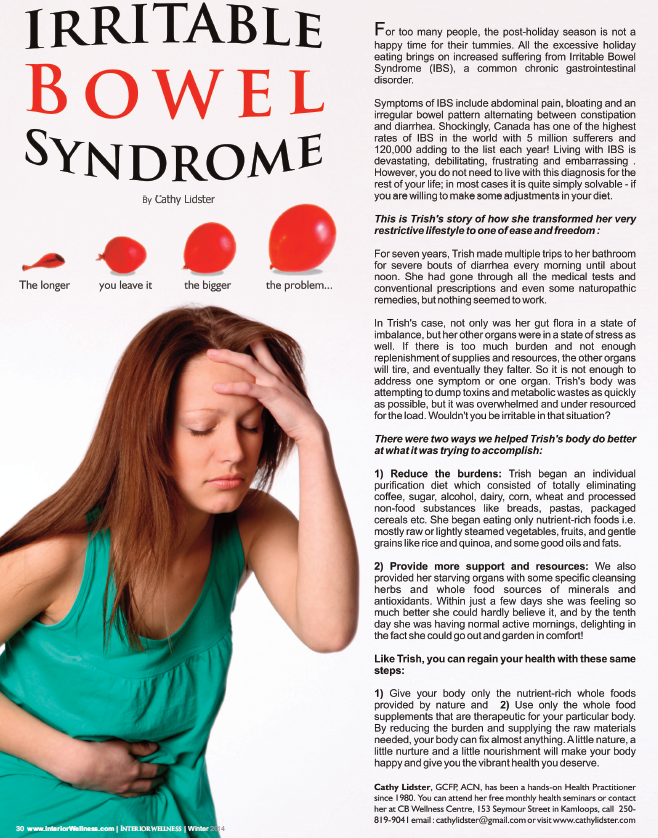
For too many people, the post-holiday season is not a happy time for their tummies.  All the excessive holiday eating brings on increased suffering from Irritable Bowel Syndrome (IBS), a common chronic gastrointestinal disorder.
Symptoms of IBS include abdominal pain, bloating and an irregular bowel pattern alternating between constipation and diarrhea.  Living with IBS can be devastating, debilitating, frustrating and embarrassing.  What many people do not realize is that it is not necessary to live with this diagnosis for the rest of one’s life.  In most cases it is quite simply solvable – if you are willing to make some adjustments in your diet.
Here is the story of how one woman with IBS transformed years of a restrictive lifestyle to one of ease and freedom in a matter of days:
Trish (name changed for confidentiality) is mother and grandmother of a large and close knit family and very involved in her community.  Only her family and her doctors knew of her suffering with what was diagnosed as Irritable Bowel Syndrome.   She made multiple trips to her bathroom for severe bouts of diarrhea every morning until about noon.  This had been going on for many years!  Not a pleasant way to live.  Trish had gone through all the medical tests and conventional prescriptions and even some naturopathic remedies but nothing seemed to work.  She had given up on treatment and resigned to live with it.  But then, her husband suffered a heart attack and that stress took her down even further.  Her husband’s wakeup call and her subsequent sudden weight loss scared her family to the point of stepping in to help and they brought her in to my office.
In Trish’s case, not only was her gut flora in a state of imbalance, but her liver, kidneys, pancreas, gall bladder and adrenal glands and even her brain, were all in various states of stress.   The body behaves like a loving family.  When one organ is compromised, the others try to take up the slack. If there is too much burden and not enough replenishment of supplies and resources, the other organs will tire, and eventually falter as well.  So it is not enough to address one symptom or one organ.  And, especially, if an organ is suppressed or inhibited by a non-nutritive, non-natural, chemical prescription in order to alleviate a symptom, there can be more hell to pay in the end, so to speak.


Elimination is the body’s way of getting rid of wastes, and it is very good at it under normal circumstances. Trish’s body was attempting to dump toxins and metabolic wastes as quickly as possible but it was overwhelmed and under resourced for the load.   Wouldn’t you be irritable in that situation?
  There were two ways we could help this body do better at what it was trying to accomplish:  
 1) Reduce the burdens:   Trish began an individual purification diet which consisted of totally eliminating coffee, sugar, alcohol, dairy, corn, wheat and processed non food substances like breads, pastas, packaged cereals etc., and eating only nutrient-rich foods i.e. mostly raw or lightly steamed vegetables, fruits, and gentle grains like rice and quinoa, and some good oils and fats.  Her family fully supported her in this project and Trish found that as long as she ate lots of the good stuff, eliminating sugar and coffee was easier than she anticipated. 
2) Provide more support and resources: This means to provide the body with the raw materials it needs to create energy for her life and bodily functions.  In Trish’s case we used some specific cleansing herbs and whole food supplements providing minerals and antioxidants.  (See Standard Process Purification Program)
Within just a few days she was feeling so much better she could hardly believe it, and by the tenth day she was having normal active mornings, delighting in the fact she could go out and garden in comfort.  At this point we added some healthy fish and free range chicken to her diet and she continued to improve. 
Trish’s story is not unique or even that unusual.  Many people are realizing that it is time to step up and take care of their bodies as nature intended.  It’s never too late to start. A little nature, a little nurture and a little nourishment goes a long way to keeping your body healthy and living  a vital, joyful life.
_____________________________________
Cathy Lidster, GCFP, NRC, has been a hands-on Health Practitioner since 1980 helping clients experience What Else Is Possible?.   For more information about whole food nutrition and Nutrition Response Testing, visit www.cathylidster.com  email cathylidster@gmail.com, or call 250-819-9041, 208-610-5756

 Find my article and others in Interior Wellness Magazine


March 2, 2010

Why Can't I Lose Weight?!?

This is a question I often get asked in my practice.
If you’re asking this question, the good news is you haven't given up hope and you still want to know why you can't lose weight so you can do something about it! That's a good thing, really.
Because I have noticed that some people just give up trying and decide that nothing can help. They usually blame themselves, their lack of willpower, a bad gene pool or something that seems insurmountable.
Or they don’t want to try again because it means they might fail again.
I understand.  It's a scary thing to uncover hidden barriers to success.  It's sometimes easier just to keep things the way they are. 
The problem is if you are feeling lousy about yourself right now, and do nothing, what do you think your life will be like in a year from now?  In five years?  In 10?
The truth is, there are many hidden forces that contribute to your weight gain and storage of fat that are really not your fault! Uncovering these forces provides you with the simple keys to unlocking your fat stores and shedding the pounds forever.
Some examples of hidden forces I can help you uncover and overcome are:
  • Hormone imbalance
  • Mineral imbalance
  • Foods or toxins that trigger fat storing and inhibit fat burning 
  • Stressors that create fat storage
  • The wrong type of exercise for your body type
  • Psychological factors

When these hidden forces are cleared up, you can set free the body's need to hold on to that extra fat.
Let's find out what yours might be. If you can identify your own personal challenges standing in your way, then you can handle them.  How does that sound to you?
And, it will cost you nothing but a few minutes of your time.
Simply click on my link to your weight loss analysis quiz and answer the questions.  I will get back to you with the answers so we can zero in on your specific weight loss challenges.  Go to http://weightlossanalysis.com/  and enter practitioner code 445-10400.
Together we can identify the single most important factor standing in your way of a slim and healthy body and you can then get started right away.
Very soon, you will be able to Smile And Be Thin again!
Cheering you on to health,
Cathy

February 26, 2010

6 Myths of Weight Control

My heart goes out to you if you’ve tried every exercise program and equipment out there, all sorts of low calorie programs , maybe B12 shots, colon cleanses and liposuction, or even a lap band – especially if you’re not seeing the results you want.
I don’t know if you’ll believe me, but you have most likely been taught diet MYTHS (or as I call them – LIES) that actually cause you to gain and keep your fat.

Here six of the myths that have steered you in precisely the wrong direction:

  1.  If you increase your exercise and decrease your calories you will lose weight.
  2. Eating fat makes you fat.
  3. Eating no or low carbs makes you skinny.

February 5, 2010

To the Heart of the Matter

As I sit at my writing table the sun is shining through the window and it looks and sounds like spring outside!

Midwinter sunshine is a rare and delightful surprise and never fails to lift one's spirit with a hopeful feeling, no matter what the groundhog says.

In these challenging economic times I find it most helpful to notice the little things that spark tiny glimmers of joy and light up a smile inside the heart.

That's how I was led to Inspirations of the Heart internet radio and came across the talk show series "Overcoming Adversities" with host, Catherine Van Wetter.

A serendipitous surprise emerged when I tuned in to listen to guest Colleen Russell, (contributing author of the recent bestseller Overcomers,Inc.) who happens to live not 5 miles from me!

Well, as one introduction led to another I was invited to be a talk show guest on the Overcoming Adversities series and it will air live this Wednesday, February 10th at 11 am PST!

So I am writing to invite you and your friends to the show, entitled "When Life Hands You Lemons..."

The show information is at

Call in number is (646) 915-9415 11:00 am, PST.

You may join the conversation live


or later, visit Inspirations Of The Heart Radio Blog for the recorded call.


I and my coauthors will be discussing how we came together, to support each other through our individual adversities and ended up forming a company with a mission to support others in the same manner.

And how we wrote and published our book Emotional Stimulus Package: Re Creating Your American Dream, and created a workshop and other services and products together in the past year and have still never met in person!

Hope to see you there!

From the Heart,

Cathy

February 1, 2010

Why Detox? Part 2: Foods That Detoxify

The word "detoxification" conjures up all sorts of reactions these days.

It has been interpreted to mean different things to different people. Medically, detoxification is most often viewed as a withdrawal method for drug or alcohol dependency.

To others it might mean a spiritual ritual.

For most of us, however detoxification is a healing strategy-- particularly if we suffer with chronic pain, fatigue, allergies, immune disorders, musculoskeletal problems, depression, brain fog, digestive complaints, headaches, cancers, arthritis and many other ailments.

Did you know that your body goes through its own natural cycles of detoxification, mostly during the night?

While you are resting, the body's job is to repair, replenish, and replace parts so that you are ready to go in the morning.

So, if you are waking up stiff and sore, or are not feeling rested, alert and ready to go in the morning then your body has not been able to do its proper job during the night.

Your body, if given the correct raw materials and not over-burdened, is an amazingly efficient waste treatment plant. The problem is that in our modern world we are living, breathing and eating in a toxic soup. (refer to last week’s blog 1/25/2010)

The best way to detox the body is to provide quality raw materials it needs to clean out the elimination pathways and filter and convert the toxins to water soluble compounds that can be eliminated

There are certain foods that help the body's natural detoxification mechanisms.

They are, of course, naturally grown foods in the form of vegetables and fruits.

Here are just some of the more helpful foods:

Lemons, oranges, caraway and pumpkin seeds, beets, endive, and escarole, the cruiciferous vegetables (cabbage, cauliflower, broccoli, watercress etc.), spinach, tomatoes, peas, yams, dandelion, kale, radish, garlic, cilantro, grapes, and berries.

Some of the more helpful herbs are: yarrow, chamomile, peppermint, milk thistle burdock, yucca root, siberian ginseng, chicory, and radicchio.

Isn't that great? Nature has provided us with all these plants and more so that we can live healthy, happy and long lives in spite of ourselves.

What is definitely NOT on this list?

Big Macs, corn dogs, pasteurized dairy products, diet sodas, bagels, pastas, breads and cereals, low fat and fat free snacks. "healthy heart" products, etc. You get the idea.

These processed products erroneously described by some as "foods" are made with human ingenuity which alas, cannot hope to meet the standards that nature has set for us.

Where ever did we get the notion of 'better living through chemistry?'

Next Week "Do's and Don'ts of an Effective Detox."